
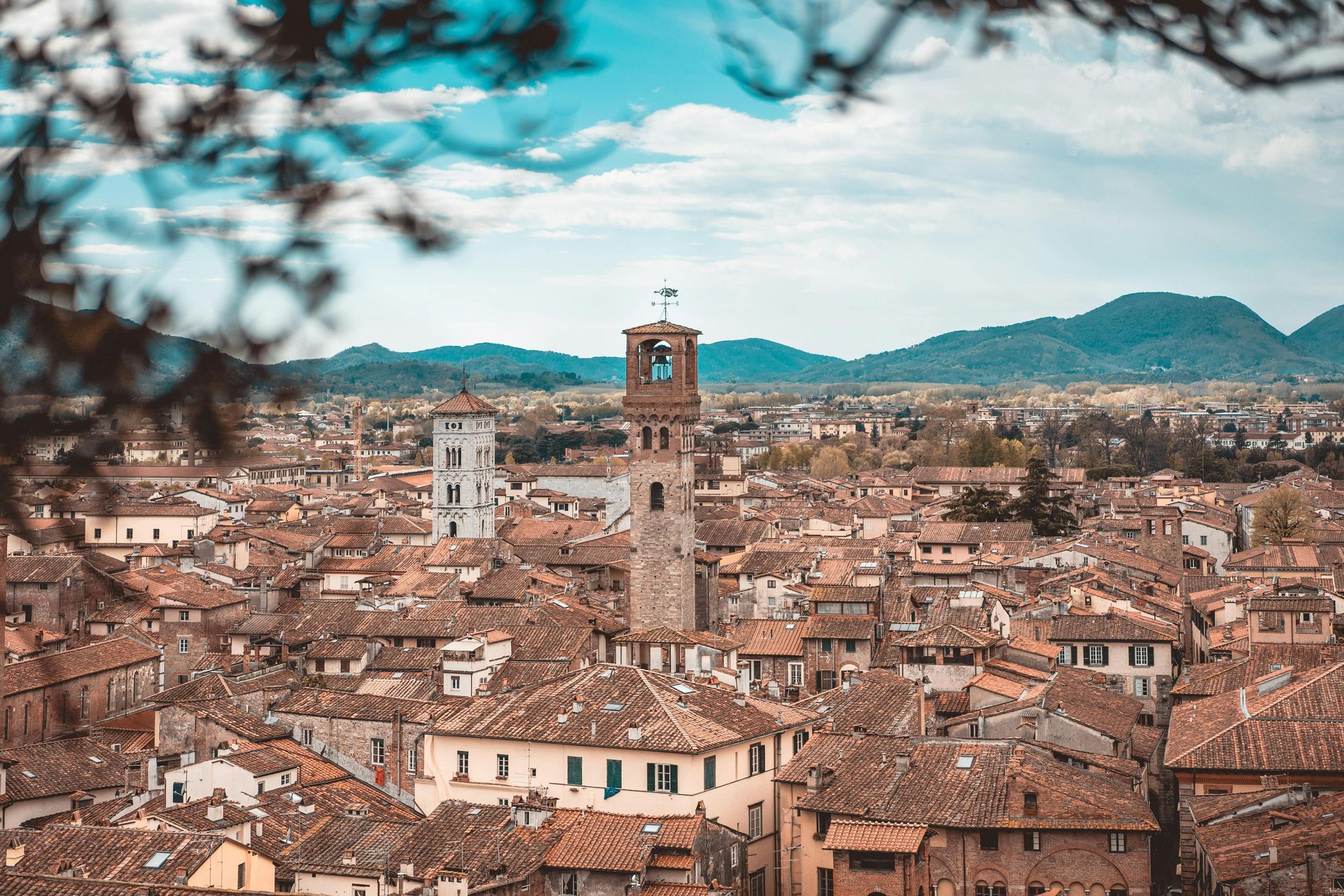
The property market in Lucca
Lucca combines city life with country life like no other Tuscan region. Inside the fully preserved Renaissance city wall, daily life runs on foot: cafes, markets, concerts. The surrounding Lucchesia hills hold historic villas with expansive gardens, one of the highest concentrations of Ville Storiche in Italy. The Garfagnana (mountain area to the north) is the most affordable zone, with village houses starting at 80,000 euros. Lucca is 25% cheaper than Florence for comparable historic substance.
Lifestyle & Living
Lucca's fully intact city wall doubles as a promenade and cycle path. The Lucca Summer Festival draws international acts. The Versilia coast is 30 minutes away, Pisa airport 30.
Market Data & Prices
The average price sits at around 2,100 EUR/m² (source: Agenzia delle Entrate, 2025). Centro Storico: 3,575 to 3,659 EUR/m², top properties up to 4,100. Colline Lucchesi (villas): 2,000 to 4,500 EUR/m². Garfagnana: 800 to 1,200 EUR/m². Prices have risen around 27% over the past five years (source: Agenzia delle Entrate). Three drivers: limited space (the wall as a physical boundary), growing international demand, and proximity to Pisa airport.
What types of property are available in Lucca?
The Ville Storiche of the Lucchesia are a defining feature: 16th- to 18th-century villas with Limonaia (lemon house), parkland, and often frescoes — one of the highest concentrations of their kind in Italy. In the Centro Storico: elegant apartments within the walls. In the Garfagnana: village houses as renovation projects, suited to buyers looking for a genuine renovation project away from tourist circuits.
| Type | Typical Size | Price Range | EUR/m² |
|---|---|---|---|
| Villa Storica (Colline Lucchesi) | 500–1.500 m², Park, Limonaia | 1–5 M € | 2.000–4.500 |
| Casale (Hügel) | 250–500 m² | 600k–2 M € | 2.500–4.000 |
| Wohnung Centro Storico | 80–200 m² | 300k–800k € | 3.000–4.100 |
| Podere with land | 200–400 m², 2–10 ha | 400k–1,5 M € | 2.000–3.500 |
| Dorfhaus Garfagnana | 100–250 m² | 80k–250k € | 800–1.200 |
How do I get to Lucca?
Pisa airport (PSA) is just 30 minutes away, with direct flights across Europe, including London, Paris, Munich and Zurich. Florence (FLR): 80 to 85 minutes. Florence city centre: 80 minutes by car. The A11 (Firenze-Mare) and A12 (Autostrada Azzurra) give Lucca strong motorway connections. By train: Frecciarossa from Bologna or Rome to Florence, then regional train to Lucca (about 1.5 hours from Florence). Lucca's station sits directly outside the city wall. In the Garfagnana, a car is the natural choice; winter tyres are advisable at higher elevations.
What is life like in Lucca?
Lucca has everything: Coop, Conad, Esselunga, a daily food market, specialist shops in the old town. The Colline Lucchesi are 15 to 25 minutes from the city. In the Garfagnana, Castelnuovo has a supermarket and the Thursday weekly market. In smaller villages, often just an alimentari or nothing at all. Lucca has a remarkably dense restaurant scene. Dinner at a trattoria: 25 to 45 euros, fine dining 60 to 100 euros. Tordelli Lucchesi (stuffed pasta) are the local speciality. In the Garfagnana, the cuisine revolves around farro, chestnut flour, mushrooms, and wild boar. In winter, some Garfagnana restaurants close for 2 to 4 months.
Schools and healthcare in Lucca
The nearest international school is in Florence (roughly 1.5 hours). Lucca has state schools at all levels. Lucca's Ospedale San Luca is a modern hospital with emergency department and specialist wards, 10 minutes from the Centro Storico. In the Garfagnana, the hospital in Castelnuovo covers basic care. Specialists are based in Lucca or Pisa (30 to 75 minutes).
Climate and weather in Lucca
Lucca city: mild winters (3 to 9 degrees), hot summers (30 to 35 degrees). The wall blocks wind, so the old town can feel oppressive in high summer. The hills run 2 to 3 degrees cooler. The Garfagnana has a mountain climate: winter with snow at higher elevations, pleasant summers (25 to 30 degrees). Heating season: November to March. An uninsulated stone house in the Garfagnana runs 4,000 to 7,000 euros per year to heat — a useful figure when scoping a renovation budget.
Tuscany at a Glance
| Region | Price/m² | Character | Airport | Sea | Hospital |
|---|---|---|---|---|---|
| Chianti | 2.800 € | Vineyards, villages | FLR 30–50 min | 1,5–2 Std. | 25–50 Min. |
| Val d'Orcia | 2.500 € | UNESCO, thermal springs | FLR 1,5 hrs | 1,5 Std. | 15–35 Min. |
| Maremma | 1.600 € | Sea, nature | FCO 2,5 Std. | 0–40 Min. | 25–75 Min. |
| Florenz | 4.200 € | City, culture | FLR 15–20 min | 1,5 Std. | 15–20 Min. |
| Lucca | 2.100 € | City walls, villas | PSA 30 Min. | 30 Min. | 10–25 Min. |
Frequently asked questions about Lucca
What makes Lucca attractive for property buyers?
Price-to-quality ratio: 25% cheaper than Florence at comparable substance. A living old town within the walls, Versilia coast in 30 min., Pisa airport in 30 min. Living costs are lower than in Florence.
What does a villa on the Colline Lucchesi cost?
Ville Storiche with Limonaia and parkland: 1 to 5 million euros, at 500 to 1,500 m² (2,000 to 4,500 EUR/m²). Casali on the hills: 600,000 to 2 million.
Is Lucca cheaper than Chianti?
Yes. Renovated Casali on the Colline cost 2,500 to 4,000 EUR/m², in Chianti Classico 3,500 to 5,500. For a 400 m² Casale, that is a difference of 400,000 to 600,000 euros. The Garfagnana (from 800 EUR/m²) has no equivalent in Chianti.
Is buying in the Garfagnana worthwhile?
For buyers with renovation budgets and a willingness for rural remoteness: yes. Village houses start at 80,000 euros. But: shrinking communities, limited infrastructure. A house in the Garfagnana suits buyers looking for a genuine renovation project away from tourist circuits.
Are there heritage restrictions on the villas?
Yes. Ville Storiche fall under Vincolo (heritage protection). Facade, windows, roof, and garden layouts require Soprintendenza approval (3 to 8 months). Maintaining the historic fabric (garden, Limonaia, frescoes) remains demanding.
How far is Lucca from the airport?
Pisa (PSA): 30 minutes, with direct flights across Europe, including London, Paris, Munich and Zurich. Florence (FLR): 80 minutes. For Lucca buyers, Pisa is the relevant airport, an advantage over Chianti, where the nearest airport is 45 to 70 minutes away.
Why are prices in Lucca rising?
Up 27% over five years (source: Agenzia delle Entrate). Three drivers: limited space in the Centro Storico (the wall is a physical boundary), growing international demand, and Lucca's position as a more affordable alternative to Florence with solid infrastructure.
Can I live in Lucca year-round?
Yes, and that sets Lucca apart from most Tuscan property markets. A city of 90,000 provides everything: hospital, specialists, supermarkets, cultural events, schools, and train connections. Lucca works as a primary residence.
Buying in Lucca
Looking for a property in Lucca? I find suitable properties, including off-market, assess price and substance, and coordinate legal and technical checks through to the notary appointment.